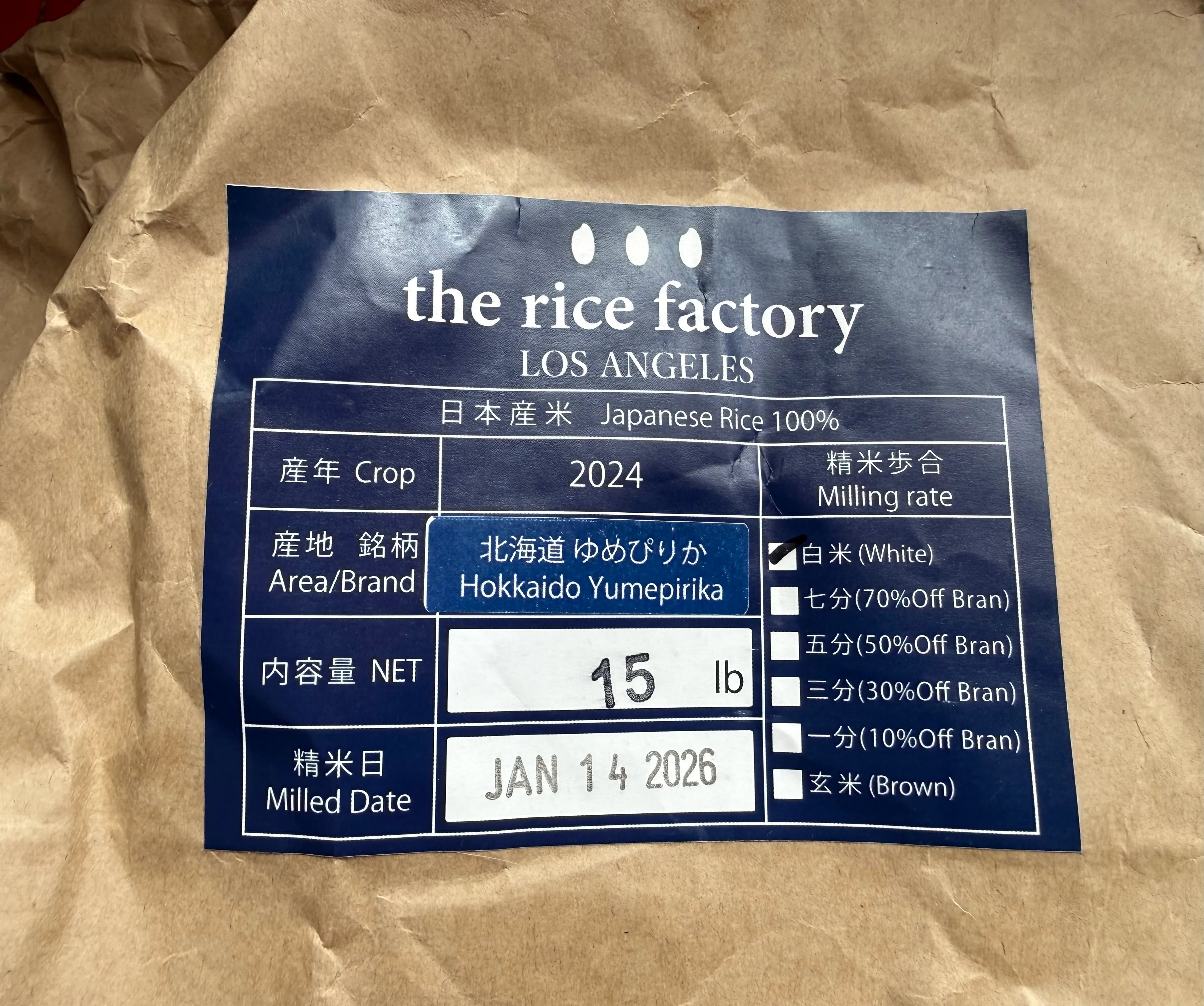
Back in December 2025, before my fancy rice era had begun in earnest, I was eating with my fiancee, kids, parents, and future-mother-in-law at a local Japanese restaurant that I had never been to. I was a little hesitant about the place, as the majority of the clientele was not Asian, and when the meal came out, the lump of rice that was served with it looked particularly unappealing. It had been scooped with a domed spoon like a large ice cream scoop and the flavor and texture were very poor compared to the regular store brand koshihikari that we normally ate at that time. I complained about this to the table, that this was a cost-saving measure to serve rice for those non-rice-snobby people who don’t know any better. My dad mentioned that there was a luxury boutique rice shop called The Rice Factory (TRF) back home in Hawaii that stocked various high end cultivars of rice and even milled them to customer specification upon ordering. This sounded highly appealing to me and the following week, my friend and I placed a large order from TRF’s Gardena branch for their number one hit, 2024 crop Hokkaido Yumepirika, which had hundreds of positive reviews, milled to white.
The shipment arrived the following day and we were impressed to see that it was stamped with a mill date corresponding to the order date. This rice was not cheap, even though it was the 2024 crop and came out to something like $3/lb. To TRF’s milling credit, the grains were uniform in size and appearance and I didn’t see any broken grains. I didn’t see any significant number of white grains either, most were translucent and attractive.
I gave this rice a little more water as it was from 2024, and soaked each batch I made of it for an hour before cooking. The cooked result was visually appealing - the grains were distinct and shiny, and held together well upon scooping. The flavor though - was absent. This is one of the blandest premium rices I have tasted and I thought that I may have cooked it incorrectly. I experimented multiple variations of water, washing, cooking in donabe, cooking in the Zojirushi, etc, and none of them yielded results that were in line with the rave reviews that I have read about Hokkaido Yumepirika. While it did have a pleasing, premium texture, there was clearly a disconnect between what I expected of this rice vs what I experienced.
I ended up using the majority of the 15 lbs of this rice as a saucy dish rice, as it definitely did not stand on its own as solo rice. The texture is a nice complement to strongly flavored saucy dishes and it doesn’t get mushy when soaked in them. The Japanese Grain Inspection Association rated this rice as “Special-A,” its highest rank. I absolutely do not agree with this rating, I would rank it as “Below Average.”
Now, some speculation as to what happened here: I think that TRF gave us something other than Hokkaido Yumepirika. The rave reviews for this cultivar and my experience with it are completely out of sync with each other. I later confirmed this by buying another bag of Hokkaido Yumepirika (distributed by Zen-noh) that came on sale from my local Japanese market. That rice was completely different in flavor and continues to be my favorite rice I have ever purchased in the US. I actually intend to buy 2 or 3 sacks at once the next time it comes around. TRF promotes itself heavily on social media and gets into trendy stores with its distinctive and attractive packaging, and much like the local Japanese restaurant catering to non-Asians, I believe that TRF is catering to wannabe rice snobs who don’t know any better. Based on their deceptive business practices, I will never order from TRF again - and why should I, when the local market has a biweekly virtual conveyer belt of gourmet rice varieties at half the price.
Photos